





Introduction
Video-Coder is a coding agent that writes and runs Blender code to build a draft video. A video generator then turns the draft into the final video.
+24VBench-2.0 over MiniMax-H3
+6PhyGenBench over MiniMax-H3
6k + 2kopen SFT / RL samples
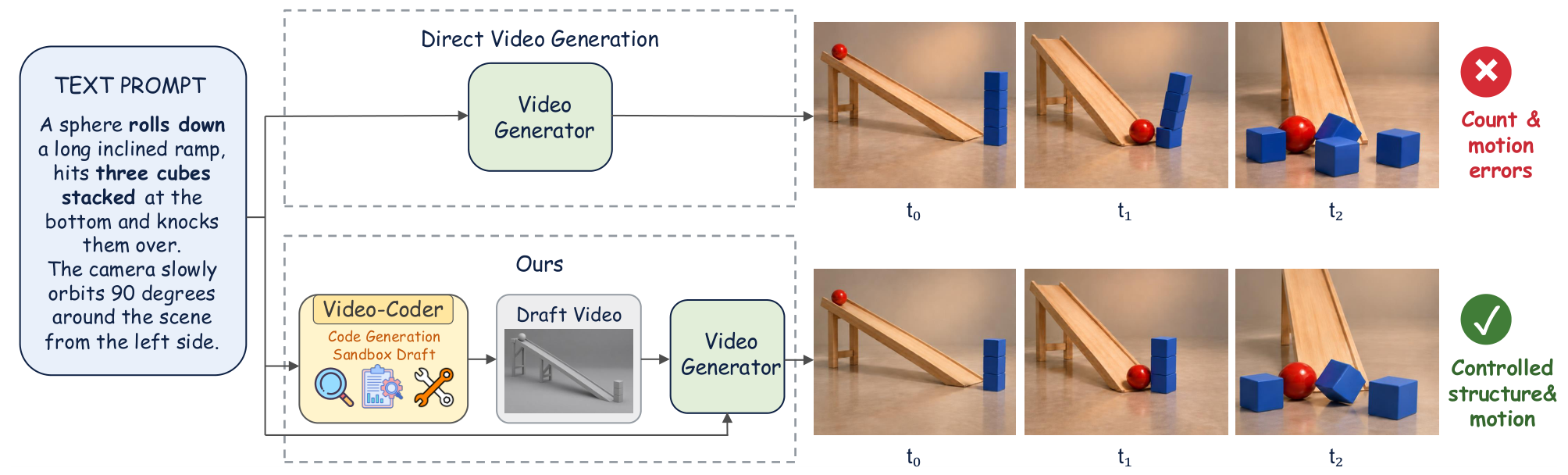
Method
The agent works in the Video-Coder Harness, an environment where it writes, runs, inspects and revises its program. We train Qwen3.5-9B with SFT, then agentic RL with an execution reward that anneals into a video reward.
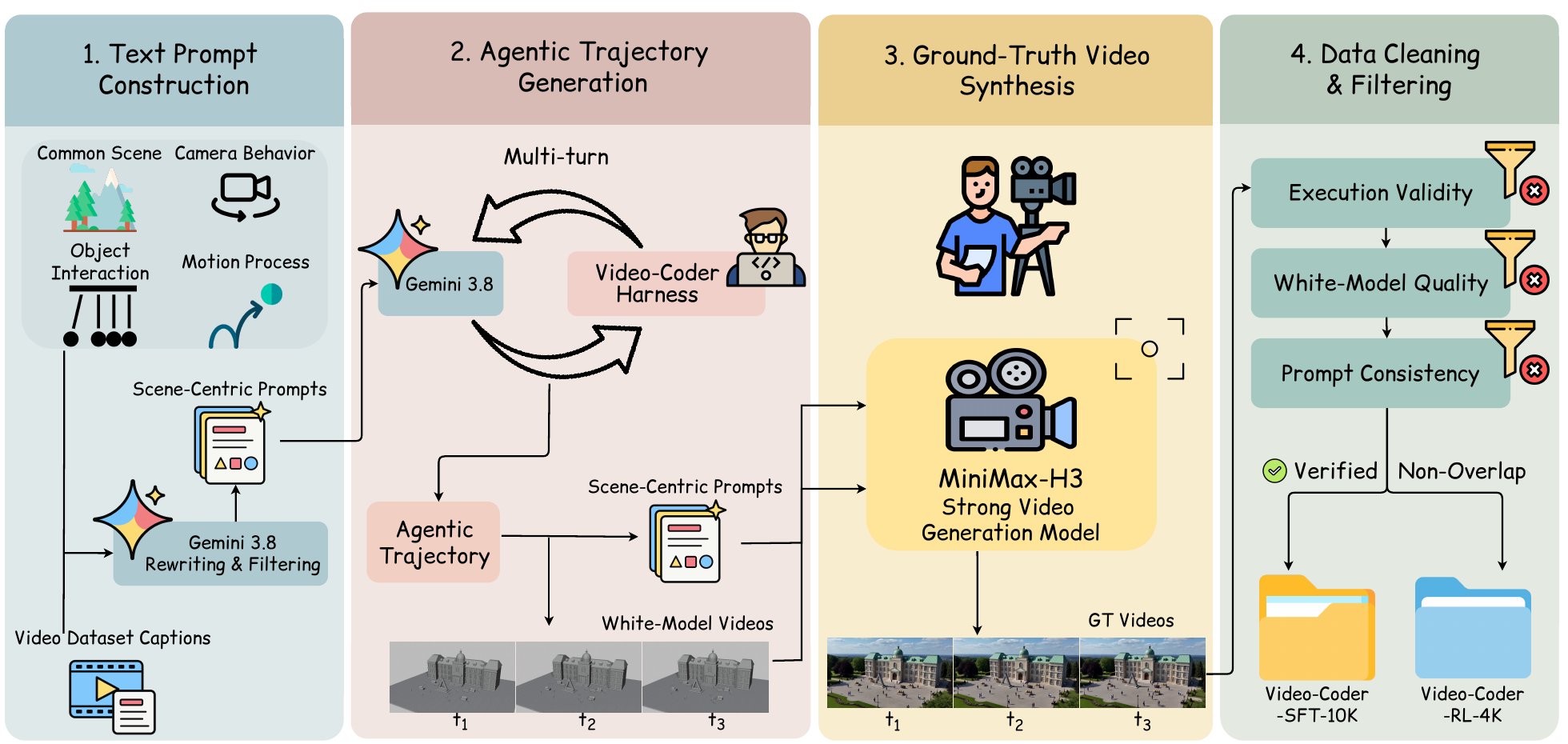
Results
Experiments show that Video-Coder consistently improves video generation performance across different backbones, bringing around 7 points gains for MiniMax-H3 on PhyGenBench, demonstrating that explicitly constructing 3D scenes with executable code effectively enhances the physical plausibility and controllability of generated videos.
| Method | Mechanics (↑) | Optics (↑) | Thermal (↑) | Material (↑) | Average (↑) |
|---|---|---|---|---|---|
| Pika | 0.35 | 0.56 | 0.43 | 0.39 | 0.44 |
| Gen-3 | 0.45 | 0.57 | 0.49 | 0.51 | 0.51 |
| Kling | 0.45 | 0.58 | 0.50 | 0.40 | 0.49 |
| CogVideoX | 0.39 | 0.55 | 0.40 | 0.42 | 0.45 |
| Open-Sora V1.2 | 0.43 | 0.50 | 0.44 | 0.37 | 0.44 |
| LaVie | 0.30 | 0.44 | 0.38 | 0.32 | 0.36 |
| Vchitect-2.0 | 0.41 | 0.56 | 0.44 | 0.37 | 0.45 |
| Minimax-H3 | 0.61 | 0.73 | 0.52 | 0.55 | 0.61 |
| HunyuanVideo | 0.33 | 0.39 | 0.26 | 0.30 | 0.33 |
| OmniWeaving | 0.48 | 0.56 | 0.43 | 0.39 | 0.48 |
| Wan2.2-TI2V-5B | 0.55 | 0.58 | 0.53 | 0.50 | 0.54 |
| Cosmos-Predict2.5 | 0.30 | 0.33 | 0.41 | 0.39 | 0.35 |
| LTX-Video-2B | 0.51 | 0.58 | 0.48 | 0.45 | 0.51 |
| Video-CoCo | 0.51 | 0.58 | 0.48 | 0.45 | 0.51 |
| Video-Coder-9B + OmniWeaving | 0.52 | 0.58 | 0.52 | 0.44 | 0.51 |
| Video-Coder-9B + Minimax-H3 | 0.68 | 0.79 | 0.60 | 0.61 | 0.67 |
| Method | Mechanics (↑) | Thermotics (↑) | Material (↑) | Average (↑) |
|---|---|---|---|---|
| Sora | 62.22% | 43.36% | 64.94% | 56.84% |
| Kling 1.6 | 65.55% | 59.46% | 68.00% | 64.34% |
| HunyuanVideo | 76.09% | 56.52% | 64.37% | 65.66% |
| Minimax-H3 | 67.59% | 47.22% | 48.94% | 54.58% |
| CogVideoX-1.5 | 80.80% | 67.13% | 83.19% | 77.04% |
| Video-Coder-9B + Minimax-H3 | 88.67% | 70.88% | 75.02% | 78.19% |
| Methods | PhyGenBench |
|---|---|
| Minimax-H3 | 0.61 |
| + Video-Coder-SFT | 0.63 |
| + Video-Coder-wo-annealing | 0.65 |
| + Video-Coder-wo-video reward | 0.64 |
| + Video-Coder-wo-execution reward | 0.63 |
| + Video-Coder | 0.67 |
Qualitative Examples
Prompt← Draft video (Video-Coder)Generated video (MiniMax-H3) →